Friday, May 4, 2012

Day 21: You are Peter …. and on this rock


A very early start to perhaps the most amazing day of pilgrimage yet. The wake-up call was 5am for a quick breakfast and onto the bus, destination Vatican City. We arrived to find the dome of St Peters shrouded in mist in the dawn light. It was at once eerie and quite peaceful. A few cars and taxis drove by, but beyond that our little group of Aussie pilgrims had St Peter’s Square to ourselves. A quick photo opportunity and then through security and into the basilica via the side entrance. The implications of the early morning arrival were about to become clear.


Entering the basilica was a goosebumps moment, my skin felt cold, not only because of the cold morning air but because of the immensity of the space. We had seen amazing things on this pilgrimage but nothing could prepare me for the sheer scale of St Peter's basilica. What a privilege… we were there on our own. The only others we saw were a few priests each celebrating Mass at an altar around the basilica and a group of cardinals processing behind each other who disappeared through a doorway to be rediscovered later. The floor of the basilica was ours to wander. We stood at the foot of the baldacino designed by Bernini that marks the spot of St Peter's grave and houses the high altar. It towers in bronze skyward towards the Michelangelo designed dome of the basilica. Beyond it, the chair of Peter adorns the back altar with a glowing mosaic Holy Spirit. And all I can here is the silence of the centuries, muffled footsteps and an overarching sense of the presence of the divine. We were given 20 minutes to explore but rather than head off on a mission I strolled, feasting on the artworks and the symbolism in this majestic space.

The tomb of John Paul II was evident in a side chapel near the entrance and then I saw the piece of art I had been longing to see. Pieta by Michelangelo: the agony of a woman embracing her dead son. Sculptured in marble it looks so warm and even soft with the folds of Mary falling gently towards the floor in stark contrast to the lifeless body of Jesus. Perhaps it was because the piece looked somehow smaller and more delicate than I had imagined, but as I stood before It I was overcome with a profound sense of grief and tears began to run down my cheeks. In a silent St Peter’s, on my own, in front of Pieta. As I walked back along the nave, the rays of dawn were streaming in through the windows above the entrance to the basilica casting patterns in the air and on the floor: rays of divine light.

We were called to the doorway of the disappearing bishops and processed across the floor of the basilica in the traditional two lines, following Eminence to the crypt level of the basilica to celebrate Eucharist in the Hungarian chapel. On the way we found the cardinals that had disappeared earlier, celebrating together at the chapel closest to the tomb of St Peter. And so, we celebrated Eucharist together and then returned to the floor level of St Peter’s to pause at the tomb of Saint Peter for prayer and a photo opportunity.

As the people were gathering for the audience and we had specific seats to occupy we made our way out to the general audience area. We walked via the main nave and saw the markings of the world’s biggest cathedrals marked in the floor, comparing their size to the basilica. The good news that Eminence was keen to point out to us is that St Mary’s Cathedral makes it on at almost 2/3 the length of the basilica. That done, we walked out the main doors of the basilica and could hardly believe what we were seeing, standing on the porch overlooking St Peter’s Square.  We were then escorted to our seats in the front section right near where the Pope would sit. We were less than 10 metres from the action. What was even more exciting was that Dan and Sue, Sam and Chris our tour director were actually going to meet the Pope, along with Eminence. They were seated in front of the barricade just in front of us. The sun was hot while we waited and then the Pope mobile arrived and he did laps of the square before driving up the stairs in front of us and assuming his seat on the presidential chair under the large cover. He looked frail and thinner than I had thought that he was. The ceremony consisted of a scripture reading from Acts concerning the witness of Stephen before his stoning. This was read by Cardinals in several different languages including English. At the conclusion of the reading each Cardinal then introduced the various groups that were present at the audience that day, according to their language. As each group was introduced there were cheers and choruses of songs. We were very excited when we were introduced as teachers from the Archdiocese of Sydney Catholic Schools accompanied by his Eminence Cardinal Pell. When each language had had their turn the dignitaries were presented to the Pope. It was very special to see each of our fellow pilgrims meet the Pope and as the photos attest, each person was very touched by the experience. I think it will take at least 'til his ordination to wipe the smile off Sam’s face, and that is just how it should be. As the ceremony was finishing we were ushered out to meet up with our superstars and to be sent off to grab a very quick lunch before meeting up again for our back of house tour of the Vatican Gardens.
Back in the gate past our favourite Swiss guards and this time onto minibuses not unlike the backlot buses in Universal Studios  to tour the gardens. The gardens occupy approximately one third of the Vatican state. They are green and fresh and beautifully kept and provide a place for meditation and prayer for the Pope and papal staff. They are certainly impressive. The little buses we travelled around in had headsets that plugged into a recorded soundtrack… it really felt like we were on the train in Universal studios seeing the sights.

After a spot of shopping time at the religious icon stores it was time for the final treat of the day: a tour of the necropolis or Scavi under the St Peter’s Basilica.What a fabulous tour. I knew that St Peter's had a crypt, as I had seen it this morning but I did not realise that the entire building was built on a city of the dead - a pagan city at that. St Peter had been killed in a circus that had existed where St Peter’s is now. He had been buried there in a simple tomb and later, even though Christianity was not the legal religion, a trophy monument, a small pagan looking temple, had been built over his grave. All around the area were huge mausoleums that contained pagan tombs. When Constantine went to build the first St Peter’s in the 4th century, he had the roof of each mausoleum smashed and then the buildings were filled in with soil and in that way the foundations could be laid for the new church. Of course the original tomb of Peter was boxed into a marble case but people forgot exactly where it was. Excavations and records indicate where it is including a graffiti wall which can still be seen. So, what is amazing and of course is no accident is that where the baldacino is located  is immediately above the tomb of St Peter. Literally upon this rock I will build my church. The other thing that was amazing is how well the frescoes in the necropolis were preserved, apparently because the soil that they filled the mausoleums assisted with the preservation. It was an incredible experience, seeing the artwork seeing the tombstones of the ancients and realizing the enormity of the story of humanity. And to think only 200 people tour the necropolis each day - another special moment.

It had been a huge day but we still had one stop, to see the Caravaggio painting of St Paul’s conversion on the road to Damascus. We stopped briefly at the Place di Popularire to enter the church where this painting is found. It was the same painting we had seen on the DVD at Leichhardt the night before we came away. It is true Caravaggio style, perhaps not as big as I had imagined it, but amazing use of luminescence. Glad to have seen it.


Our day continued as we met up with my former colleague Enid for pizza and gelato at the Fontanne di Trevi. What a hoot of a night we had and the Trevi was ssoooooo crowded. And so I came to the end of an amazing overwhelming day, a day when words are not enough to describe the beauty, the grandeur and the connection to the story of God’s people for 2000 years. I am a member of that church, called by baptism to be priest, prophet and king. Called to witness and proclaim. I feel so privileged and humbled in the shadow of the memory of the day.

Thursday, May 3, 2012

Day 20: Walking with a very troublesome woman


It was a quiet morning at leisure and many of the group was heading off to the religious shopping district to buy goodies to take back to Australia. Given that Chris was not feeling fabulous and needed a visit from the doc,  I decided to stay pretty close to the Domus with him, went for a walk, mooched around, took some pics of this amazing piece of Australia in Rome and had a lovely lunch at a trattoria around the corner...Veal Limone and Rigatoni Meatball. Yum!

The afternoon session was a pilgrimage walk in the footsteps, not of St Paul this time, but of St Mary of the Cross MacKillop, that very troublesome Aussie woman.   Mary journeyed to Rome at a very turbulent time in Italian history to visit the Pope and gain papal approval for the rule of her sisters.  So we headed off in light rain, past Termini Station where Mary would have arrived in Rome and then on to some of the places where she either lived, prayed or sought support.  One point of interest was St Andrews’ church, place of regular worship for Mary and the place where St Stanislaus Kostka lived, a young Jesuit seminarian who was canonized for his good works. The chapel is small but quite stunning with a lot of coloured marble. Beyond this small chapel we saw the Presidential Palace, not that it had anything to do with Mary per se but it was an important part of Italian history. The next stop was to be at the Church of St Agatha of the Goths which is a tiny church that was originally home to Aryans who supported the Aryan heresy that denied the divinity and humanity of Christ. When the Aryans were overthrown in the 6th century the church reopened as a place of Catholic worship. It was a surprising little oasis of peace. Looking fairly run down and small from the street, we descended into a courtyard and entered through small doors into a beautiful worship space where quiet organ music was playing. A real sense of history in the nondescript building. 

Moving from there we stopped at the Convitto san Tomaso which was originally the Irish College in Rome. Here Mary worked to prepare her case for the Vatican and we were fortunate to be welcomed by Dominican Father Luke who showed us into a tiny and rather Spartan chapel with a stunning contemporary tabernacle. We paused for prayer again in this beautiful place. Passing several other sites including the Trajan market and the Forum we ended up at our final destination, the home and death place of St Ignatius Loyola, founder of the Jesuits. The Church of the Gesu is next door, and here we saw an amazingly ornate ceiling which the Cardinal described as perhaps the best vision of heaven he had ever seen.  We shared Eucharist together in a small chapel within this massive space, before viewing the arm of St Francis Xavier which is housed in a large reliquary at the front of the church. Eminence tells us that this relic is touring Australia later in the year!
It had been another interesting day, perhaps today seeing things that only pilgrims to the holy city would be likely to see. The little churches along the way revealed stories that both educated and inspired. And so ends another day.

Wednesday, May 2, 2012

Day 19: The ABC of Roma.


Roma! Ah what  a lovely word. And today begins the touring of significant sacred sites in the eternal city. I will leave you to decide, good readers, on what the acronym ABC stands for... I know there are a few suggestions but for me it is All Basilicas and Cathedrals. And so the day began with excited Aussies sitting at Breakfast surrounded by bacon and egg, and vegemite on toast; small home comforts after a week of cucumber and olives in Turkey. It was off to Mass at our first stop St Paul’s outside the walls.

St Paul’s outside the walls is the place of Paul’s burial as the Romans would not allow burials to take place inside the city walls. It is not the original church which had been destroyed by fire and this one was totally rebuilt in the 1800s. Very  little remains of the original structure except for the cupola that towers over Paul’s grave. The basilica is a great example of pre-Vatican architecture as we celebrate Eucharist together in the side chapel dedicated to St Benedict. There were others dedicated to Lawrence and the Holy Cross. The artwork is nothing short of exquisite. Mosaic work in gold adorns both the exterior of the top of the building and the interior. Images of the popes of Christendom line the top of the nave with the spotlight focused on the current pontiff. The cavernous space swarming with people, some totally engaged and some seemingly disconnected from the beauty and history that surrounded them was an interesting study in people watching. After Mass our guide pointed out all of the important features and then we left to explore a very different type of place of worship.


Second stop of the morning was the Catacombs of St  Domitilla. This was the site of burial of many of the early Christian martyrs and other Christians who wanted to celebrate Eucharist nearby the holy places of burial of the martyrs or who needed a place of burial at a reasonable cost. Of course it too is outside the city walls, because there could be no burial within the ancient city.  The entrance at ground level belies the myriad of tunnels that lies below. Unfortunately there is no opportunity to take photographs in the catacombs so once again I rely on the eyes of my mind for the memories.( and a little help from the internet) There is a simple and unadorned chapel  30 metres below the ground and the catacombs go down 4 levels below that. While legend might have it that the catacombs were hiding places where the early Christians lived this seems not to actually be true. They were not actually a hiding place. The first Christians could not have lived in there as there was simply  not enough oxygen to sustain long term living. As we walked through the tunnels on the second level we saw niches in walls covered by either terracotta or marble. The body was simply paced on shelf and the sealing indicated the relative wealth of the person with the rich having marble grave closures and the poor only terracotta. It is estimated that 150,000 were  buried originally in this catacomb alone. Only about 2000 graves remain intact and they’re on the lower levels. Over the years there have been issues with grave robbers and also some bones of martyrs (testifying to faith) have been moved to other places such as below the Pantheon in later Christian times. The tunnels are cold dark and eerie but strangely beautiful and inspiring. Artwork revealed early frescoes in solid colour and  carvings of the anchor and the fish, the early Christian symbols. They are  naïve in style and they tell the story of a faith filled people. To connect with those who did so much to sustain faith is inspiring and the simplicity of the space is humbling.


Lunch was had under an umbrella at a café in the street next to the basilica of St Mary Major with Chris H and Paula our tour guide. St Mary M is a  huge church the central section of which dates back to the 4th century. Little of the original work is in evidence due to several restorations however it is another fabulous example of religious art. The earliest mosaics are found on the arch above the central altar and they tell the story of Jesus passion and death and feature Bethlehem and Jerusalem, place of birth and place of death. The side chapel where no photographs can be taken contains an icon to Mary dating to the 500s that is mounted behind an altar in the same chapel as the tomb of the  Borgese Pope whose family funded much of the work on the church. Here I also encountered the notion of the holy door, an entrance way to the basilica that is only opened in Jubilee years, once every 25 years or so. It features two of the titles of Mary: Mater Dei and Mater Ecclesia and has beautiful relief work. I think I am beginning to better understand the reasons for the immensity of these majestic buildings and their purpose. They are not only places of worship but they are statements of the centrality of western Catholicism in an historical period where the power of Islam was significant and the beauty of the worship spaces of Orthodoxy were also so obvious. Competition seems like an ugly idea, but realistically that is what it is and a way of teaching and assuring believers of the immensity of the story of salvation. With more majestic churches on the itinerary I am sure there is more to think about here.

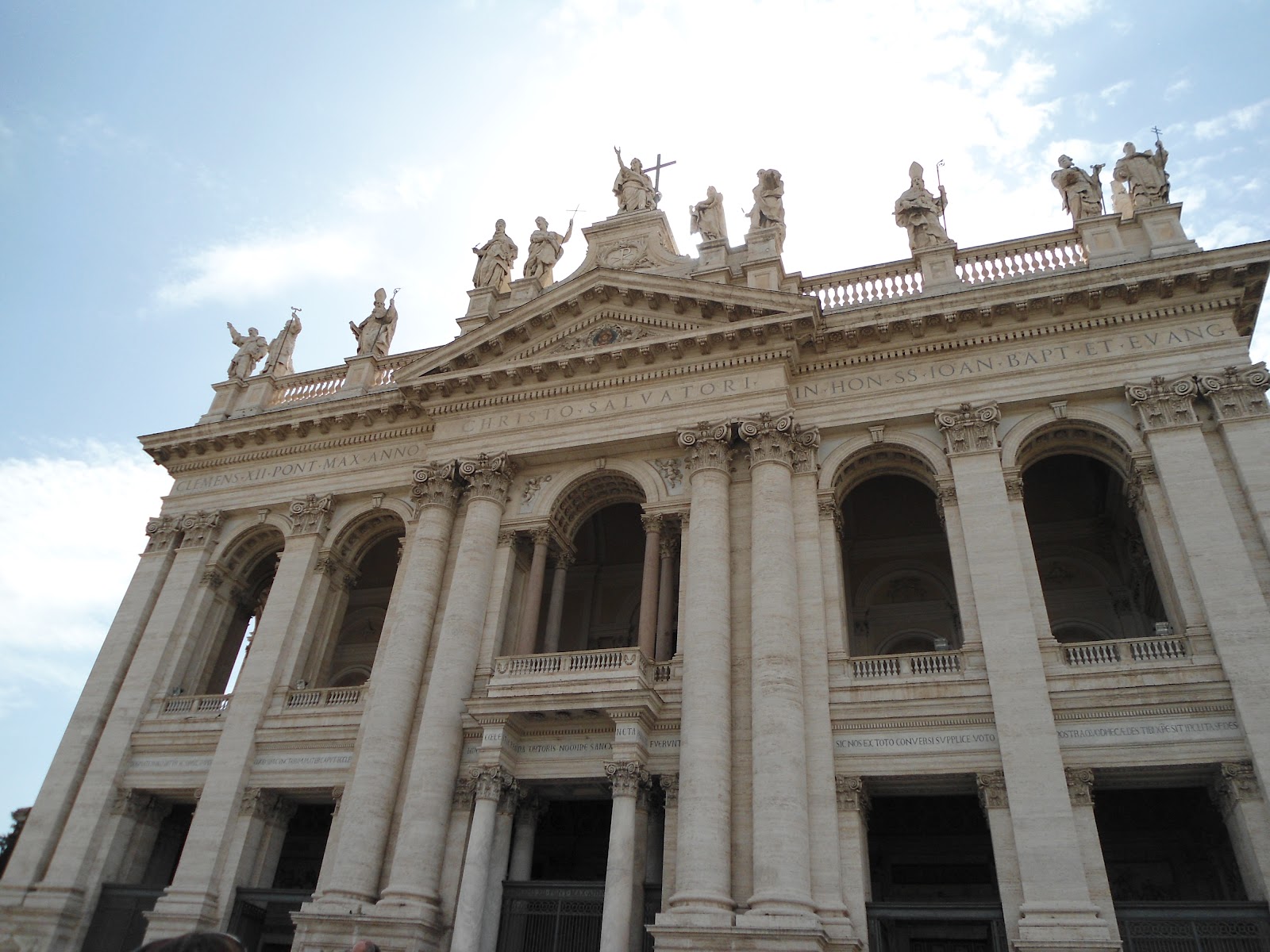
Back on the bus and we arrived near the walls of the ancient city to find the basilica of St John Lateran, the cathedral church of Rome. In the surrounds there was scaffolding everywhere as there was an ongoing concert of some description with techno lights and lots of sound. The juxtaposition of this against the white marble of the church with its sainted figures towering and bending on the rooftop originally commissioned by Constantine flaws me. A city of contradictions is this Rome. This is the “Pope’s Church”. Following election the pope claims his church within the first month. It is a cavernous space with double side aisles. The statues of the 12 apostles that line the central area of the basilica are imposing, somewhat scary. In the centre is the towering canopy containing two golden statues which house the heads of St Peter and St Paul respectively. Reliquaries abound, with one on the transept containing the remains of the wood of the table of the last supper. Side chapels line the sides of the church, many of which used to be owned by influential families but which now, with one exception, belong to the church. We even saw an original Giotto icon. The mosaic work which is renaissance and later is stunning and perhaps a little more stylized than the previous churches we have seen. I am in awe. I had not understood the need to have a feast of the dedication of the basilica on St John Lateran on the liturgical calendar. It seemed like an odd thing to do in Australia, so many miles removed from Rome. I will now have a new appreciation of that feast and some fabulous images to share with the students when we prepare class Mass. And that was not the end of the day… there were two more stops before home time.

At the church just across the road, many of the pilgrims in our group ascended the Holy Stairs said to have been walked on by Jesus and brought to Rome by St Helena in the 4th century. The only way you can ascend these stairs is on your knees. Clearly not MY knees. But I stood at the bottom and watchds and prayed supporting my fellow pilgrims on the climb, not to mention holding a few bags and jumpers. Watching his Eminence ascend the stairs in prayer supported by Sam was very moving and when he shared that his prayer had been for our pilgrim group and our intentions it was all the more special.
The final church of the day was the church of the Holy Cross. An interesting place said to contain the true relics of the Holy cross brought to Rome by St Helena. The reliquary certainly attracts a good deal of attention and focuses people in prayer because the tiny chapel was very quiet and pilgrims were very respectful in this space where they do not allow photographs.

It had been a long day of visits and reflections and there was still more excitement to come. We were told that dinner tonight at Domus was to be a special affair and that we had to be ready downstairs at 7pm. We were ushered into the “crypt” which is a lovely function area where we were greeted with wine and pastries and welcomed to the Italian night. What an amazing sight. The room was all decorated and the food looked and tasted fabulous and then two Italian troubadours arrived and started the serenade. They were getting everyone involved and at one stage several of the girls, me  included, were up singing New York New York. It was a great deal of fun and I think a test run of the Domus staff and their catering. Just a fun night. As it had been such a big day it was time for bed. Ah sleep in a comfy bed. So overrated on pilgrimage but a reality at Domus Australia

Monday, April 30, 2012

Day 18: Leaving on a jet plane (or two)


Today has been a very long day with very little to report. We bid farewell to Kayseri, which I learned this morning is the ancient place of Caesarea. The luggage is becoming a problem for some in the group but not all. We checked in, moved through to the human hoarding pen and waited to be called for the flight to Istanbul. Finally off in the direction of Rome. Istanbul airport is much bigger, and there are some eateries on the airside of customs, so we took over the food court, grabbed a tea while others grabbed lunch and then we mooched 'til it was flight departure time. Another little delay and it was off to Roma!! That is where the wheels fell off!


Arrived through customs at Rome to realize that I had left the Kobo on the plane and went in search of Chris to see if it could be retrieved which it was… but my news seemed positively second rate in comparison to the 10 or so that had lost their bags, apparently a whole trolley went missing, which, given what we saw of plane stuffing, this was going to be a problem. So some travelers came to the bus without their bags and we journeyed into Rome and to our accommodation to discover that all bags and my book had arrived. On the way in we did a burn past the Colosseum and other significant buildings in and outside of the city walls. So it was off to Mass, but first we needed to enact the Heathcliff and Kathleen scene from Wuthering Heights. Chris woken and rinsed off, made it to greet me in the cloisters and then it was time to have Mass and the dinner before bed.  Roma… finally here!!!


 and what Chris did....

My jet planes started yesterday when I left Sydney bound for Rome to catch up with Liz and the other pilgrims.

Early morning arrival into Rome. I headed out to meet my driver, organised by Harvest - he had a little English, I had a little Italian, buon journo, hello. Travelling into Rome early on a Sunday morning is great. We had no trouble and made good time. We even went pass the Colosseum on our way into Rome. No problem finding the Domus as I had googled its street view. Only problem was very narrow outside, and buses tear through.


After breakfast (with Lamingtons no less) I caught the train out to Ostia Antica, the ancient Roman port on the Tiber. This was to be my first ruins experience since Liz had had so many over the last three weeks in Greece and Turkey.

Ostia is well preserved, and the printed guide I had downloaded from the internet was useful in seeing the important sites, like the temple precinct, the fish seller's stalls with their mosaic floors of dolphins and Triton, and the amphitheatre which is in excellent condition.

Back in Rome I checked out the entry to the Baths of Diocletian - 1900 years old and full of statuary. Then a short walk back to Domus.


Of course I was exhausted, so I went off to sleep, to have the phone ring to tell me the pilgrims had arrived and it was time for Mass. It was a very special moment to share Mass with Liz again, and to meet up with the pilgrims.

Day 17: We will ROCK you!


Today’s big adventure started very early for some of the younger members of our crew as they set off at 4am for an optional hot air ballooning expedition. We were relieved to see their exuberant faces at breakfast where they entered triumphant having had a fabulous time. The photos of the hundreds of hot air balloons in the air together were a truly amazing sight. 


Our first stop today was the underground city of Kaymakli. This city is built in caves which occur in volcanic ash rock that can be relatively easily hewn. This area is purported to be the underground escape for early Christians to hide the persecutions. It involves tunnels and chiseled stairs with “cave rooms” to the left and right of the path. There was a food storage area, a chapel with a little stone that looked like an ambo, a kitchen, with a large stone with little circular recesses, used for grinding herbs and spices, a ventilation shaft and many other unmarked rooms. Moving through the cave complex was claustrophobic, the corridors only just being wide enough to walk through and so short in places that I had to be bent at 90 degrees to get through them before emerging into somewhat more cavernous areas. This was no place for the fainthearted or the claustrophobic and it certainly gave my legs a workout.

We moved on from the underground city, heading supposedly to a cave church where we were to have Mass. Unfortunately on the way another group beat us to it so we rescheduled the day and headed off to see a pottery workshop and store. For those of you who know how I feel about these scheduled tourist stops, it felt a bit like a pearl factory in Hawaii… but it was really very entertaining. A potter showed us how he hand throws and manually pedals to make a circular jug centre and then Steve had a go at playing master potter. I think I have well increased my personal stash of 'God as potter' pictures. After the demonstration and tour we saw some absolutely exquisite pieces and many in the group bought beautiful pottery and had it shipped home. It was then time for Mass and so just out of the small town of Avanos. We stopped, seemingly in the middle of nowhere. 


A short walk down a path revealed a small cave that had walls decorated with some crosses and other religious symbolism, A little work had been done on the space because there was a sanctuary and there were wooden benches for the congregation, but it was all  quite original and so very simple and beautiful. After the hustle and bustle of the other tourist spots we have been in to in Turkey in recent days, it was lovely to be somewhere spiritual that we had to ourselves. Mass was lovely and the elegant and ancient simplicity of the space made for a very prayerful experience , in spite of the somewhat challenging choice of reading… let’s face it, it wasn’t going to make much difference what spin Sam put on Paul to the Ephesians “wives be obedient to your husbands” it wasn’t going to be good. 

Mass over, it was lunchtime and we went to the tiny tourist area at the foot of the Goreme World Heritage Park to have gozleme. A funny experience really. The menus were placed on the table and then we were told that the only thing we could have was gozleme, and there was no spinach into the bargain. Still it was a yummy lunch and time then for a quick shop before heading up to the Open air museum containing the early monastery churches dating back to the 4th century and possibly before.


This was fairy chimney country, and again the softish volcanic ash rock made for an ideal material for hewn chapels in the rock. Unfortunately there is no pics of the inside of the building so you will have to imagine the interior, although the internet has helped me a little here! The earliest chapel of St Basil was quite amazing with its fairly monochrome red and unique line sketches and naïve frescos that are badly faded and aged. Still it gives a great idea of the evolution of early Christian art. We went into another couple of chapels, with varying degrees of paintwork. It appears as though the original straight onto the wall paintings had been plastered over and frescoed in places. The most impressive of the chapels is the DARK Chapel. So called because for some time it had been used as a storage area and was locked away, preserving the colorful frescoes of Jesus, Mary the saints and the evangelists. It is a truly amazing piece of art and most of the murals date to about 11th century. Wow, underground byzantine architecture.

Back to the bus and a final photo opportunity for very weary travelers was at the fairy chimneys that are topped with an igneous outcrops. This has given them their quite distinctive shape, but by this time the group had almost lost the plot and wanted to head back to the hotel to organise the ever growing luggage for our departure from turkey tomorrow. As I pottered around the hotel packing (after getting the wrong laundry back it’s not good!), I realized that there was such an incredible cost in being an early Christian. Today we are so lucky to be living in a free and relative tolerant religious society so different to that of the persecuted ones in the early years. What has it cost me to be a Christian? It cost my forebears so much. I am blessed.

Day 16: Caught in a theological and cultural time warp


Another morning of packing suitcases and leaving hotels. We would bid farewell to Istanbul today, but not before enjoying a beautiful breakfast rainbow and then playing exotic bag stack in the elevator in an an attempt to get all of our bulging suitcases down to the lobby for departure. When you see this stairwell you don't wonder why we needed to stack the lifts. We then spent three and a half hours of sightseeing, caught somewhere between ancient Roman history and the 17th century, I am talking about our visits to the Hippodrome, Blue Mosque and Hagia Sophia  or the Church of Holy Wisdom.

We started with the Hippodrome. Reminiscent of the chariot racing scene in Ben Hur, the Hippodrome was the ancient Roman cultural sporting and political centre. The area which is still a local meeting pace contains three obelisks. The first dates back to ancient Egyptian times even though the granite on it makes it look almost brand new. It was transported to this part of the world from Egypt in about 300 BCE but it took over a hundred years for them to be able to move it into place in the hippodrome. The second monument is greenish copper and is missing the three snake motif from the top, but it is an early 5th century monument whereas the last obelisk is only dating back from late Byzantine time. They are all very beautiful and the oldest one has a marked base which tells about the chariot races and the development of the blue and green teams and their subsequent development into political divisions in the city.


Adjacent to the Hippodrome is the Blue Mosque or the Sultan Ahmet Mosque. Here we moved forward in history to about the 1700s when this building was created. Lining up at the visitors entrance we took off our shoes. It was like stepping into a beautiful blue haze. The Nicea blue Isnik tile work from which the mosque derives its nickname dominates the interior of the building and the stained glass on the side that faces Mecca is exquisite. The lights hang low in the mosque because originally they were oil and paraffin lamps and needed to be able to be reached from floor level before the days of switches! All the features of a mosque were there, and this mosque has 6 minarets. This is most unusual because most mosques have 2, the sultan’s mosque may usually have 4, but this one has 6 because Istanbul was the centre of Islamic life in the Ottoman Empire when it was built in the 1700s and it was desirable for it to have an extra minaret over the mosque in Medina that has 5 minarets. Shoes refitted we walked across the square and stood in time between the 4th century and the 17th century, between the Christian world and the Islamic world as we stood between the Blue Mosque and Hagia Sophia. Holy Wisdom.  

The building that stands here in the heart of old Istanbul today is the third church to have been built on the place. The first, built by Constantine in the 4th century was destroyed with little remnant, the second built in the 5th century is in evidence with its lintel and foundations apparent near the entrance to the present 6th century Byzantine masterpiece, built by St Justinius in about 7 years. It was the cathedral church of byzantine Christianity until the Ottoman invasion in 1453 when it became used as a mosque. In 1930 Ataturk decreed that this was a building for the world and so today the Hagia Sophia is a museum which tells an amazing story of the genesis of Christianity and the power of Muslim influence over time. It is a huge overwhelming outstanding building. The outer narthex is bare walled with no remaining evidence of the beautiful frescos and mosaics that covered it. In the inner narthex there is some evidence of the paint work and mosaics with their glistening guilt and glass. Once overstepping the threshold I became engulfed by this enormous worship space. As it was most recently a mosque, and of course because Turkey is a predominantly Muslim country, the most dominant religious embellishment is still Islamic. The discs with the names Allah Mohammed and the 4 righteous Caliphs definitely dominate the space as does the mihrab and minbar. But above all these is the uncovered and restored image of the Virgin mother in amazing mosaic. Restoration on the arches to the side reveals four angels one of which is fairly well restored. To imagine the entire building covered in these beautiful artworks is really mind-blowing. We went to the upper gallery up a very very long ramp and from the top the perspective was even better as we walked around the gallery and saw mosaic pieces and could look down and get a different perspective on the hugeness of the space and an understanding of infant Christianity emerging from persecution to grandeur in the world as represented in basilica architecture. Two significant pieces of the basilica really caught my attention. The best preserve mosaic is at the entrance to the inner narthex and features Christ in the centre with Justinius and Constantine on either side of the Saviour. The other feature was the baptistery that is found in an ante courtyard. Apparently, it is a vessel of marble that could have been able to be free standing, unlike the earlier ones we had seen that were hewn from rock and lined with marble. What an experience that was. 

It was time to head to the airport and undertake the exotic dance that is group check-in. I think the staff had a heart attack when they saw all our bags, as we Aussies don’t travel light! The flight was smooth and only took an hour and we had arrived in the mountains of Kayseri, with their snowcapped peaks. About an hour from the airport is our hotel, in the middle of a high rise semi deserted town in the middle of nowhere, our stay for the night. Mass at tables in the conference room made for an interesting experience and the Cardinal’s homily on the nature of Christ and belief was an interesting juxtaposition to the Holy wisdom we had experienced today at Hagia Sophia. And so to bed at the end of another day of sensory overload. What a blessing this pilgrimage is.

Day 15: It’s Istanbul … not Constantinople…. How bazaar!


Sleep was deep and restful after such a big couple of days and today’s program was not any less packed. Our first stop to share Eucharist which eminence celebrated at the Church of St Peter and St Paul, a short but very steep walk from our hotel. This tiny catholic community numbers only about 30 parishioners and is run by a Franciscan. He spoke to us with the Cardinal translating from the Italian to lament the disintegration of the Catholic presence in Turkey with a massive decline in numbers overall from somewhere in the vicinity of 40000 to 4000 in the last 50 years. Mass was beautiful as was the church with its gilt icons and the enthusiasm of the parish priest in the face of such incredible adversity was quite inspirational. Mass over we headed off towards the  ferry wharf for a cruise on the Bosphorous. Some of us, self included, were feeling a little reluctant after our previous “cruise” experience, but this one was just fine. We cruised downstream to the meeting of the seas and then turned back around and sailed back towards Istanbul.


 I was struck by the diversity of architecture in the city, of the dominance of the landscape in the inner city by the Blue Mosque and Hagia Sophia, not to mention Topkapi Palace, and the ostentatious private river transport that was docked along the waterfront. There are two large suspension bridges spanning the watercourse, and these bridges literally link 2 continents, as this is the join between Europe and Asia and I think that symbolically that says a good deal about the place that modern Turkey finds herself in... suspended in some ways between east and west.


I spent the outward trip on the upper deck but as the wind became unbearable it was easier to enjoy the return journey from the covered downstairs deck. While on the top level I took the liberty of trying Turkish Apple tea. Yum!


After the cruise we went to inspect the Basilica Cistern. On the way it was funny hearing some in the group asking about cisterns as if this were a toilet. The Basilica cistern is one of many underground water storage facilities that provided water for the city of Constantinople from roman times. Built sometime in the 500s CE it had evidence of recycled stone materials, as there was an interesting column from a pagan temple and two large pillar bases featuring the head of Medusa, one turned on its side and one upside down. It was a cool wet place, but an amazing indication of the architecture of the time and it rightly lives up to its name as Basilica cistern because with all the arches and columns it does look like a Roman basilica.

Topkapi Palace was our next stop after a quick Turkish kebab for lunch, followed up by some Turkish delight. Yum!! This was the home of the Ottoman sultans from the fall of Constantinople. It was a massive property with magnificent buildings and beautiful gardens. On display was a collection of jewelry including a huge diamond of about 80karat. The most intriguing place for me was the relics room. It was decked out in original Iznik blue tiles and contained bizarre dead bits of saints such as the arm of John the disciple. There was also some of the works of the prophet Mohammed and some old garments dating to the 15th century. In the final room an Imam was chanting passages from the Qur’an. It was a very interesting experience.

And then the stop that many on the pilgrimage had been waiting for… the Grand Bazaar!!! Shopping!! Some in the group were very adventurous and bought leather jackets and beautiful jewelry, whereas I stayed safe with scarves and a coupe of trinkets. It was a lot of fun but quite overwhelming as the sellers tried all sorts of flattery to get you to buy their goods.


Dinner was at the hotel on the 10th floor and this time we watched a beautiful Istanbul sunset and the twilight lights of the city reflected off the harbour. This was indeed a million dollar view. Unfortunately the special dinner that was prepared for us tonight featured 3 different kinds of fish, two with heads intact and the smell and the taste were overwhelmingly stomach turning. I am led to believe that it was a very special Turkish delicacy... struggling a bit, but the first course of broccoli soup and the company and hilarity on the table more than made up for the fish. And so another day on pilgrimage ends.